

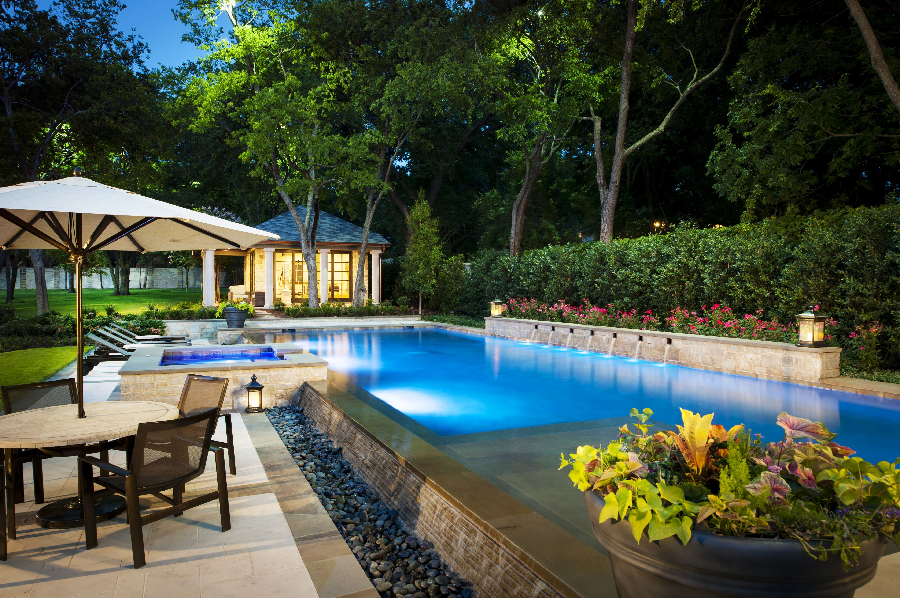
There’s quite a lot more to designing an in-ground swimming pool than simply digging a big hole in your backyard, lining it with tiles and adding water. One of the most important considerations is the size of the available space, and you’ll also have to carefully consider the location, shape and any desired landscaping as well as how you and your family might use the pool.
Size and Shape
Of course, the size and shape of your available plot will help to determine the size of your swimming pool. Although it’s tempting to install the largest possible pool, it should blend into your space and complement the other features, rather than completely dominate that space. And of course, you’ll want space around the pool to just sit and relax, or to entertain. A larger pool means more time spent in cleaning and maintaining it, and it will cost you more too. Most in ground pools are rectangular, although of course they don’t have to be. If you have the space, want to create an impression with a striking pool design, or have an odd-shaped area of land, you may want to consider another shape. Pools commonly come in circular, oval and kidney shapes, as well as shapes that just don’t fit in any category. A pool that isn’t a conventional shape will be more difficult and costlier to install.
Keeping Fit or Pool Parties?
Another consideration when designing a swimming pool in your backyard is what exactly you’ll be using the pool for. If your main goal is just to swim a few laps every day before breakfast, a long and narrow pool might work, while if it’s a pool used by kids, then a pool shape that lends itself to large gatherings might work better. You’ll also have to decide whether you need a sloping bottom on the pool, to allow for a shallow and a deep end. And if you love to entertain and have family or friends socialize by the pool, the area next to the pool becomes just as important as the pool itself. A pool and its immediate environment can be relaxing and peaceful, or it can be one that’s ideal for eating, drinking and partying.
Other Considerations
Don’t forget to take into account any underground cables, pipes and other fixtures when designing your backyard pool and choosing its location. And if you are installing a pool on land that is sloping, it can be challenging, although many pool designers and homeowners see it as an opportunity to really get creative. You can pay an expert to design your pool, based on the criteria above, or you can fairly easily design your own with the help of a range of apps, computer simulation programs and other software. There’s no doubt that seeing how your finished pool will look can make the process of designing and installing one a lot easier; it can also help you to come up with and stick to a realistic budget.
If you are looking to install a pool in your backyard, contact us now.
