

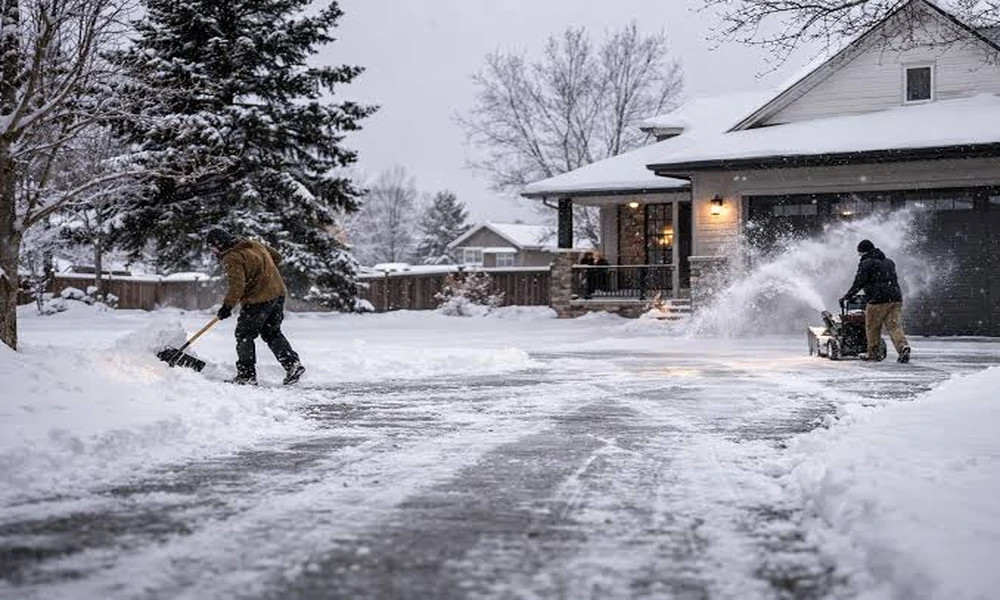
Lethbridge winters have a rhythm that newcomers learn quickly. A storm drops a few centimetres of snow, a chinook arch sometimes appears over the mountains soon afterward, and by the afternoon the driveway is dripping and the gutters are running. Then the sun goes down, the warm wind drops, and everything that melted freezes solid. That cycle can repeat again and again over a winter, and it is a big part of why a Lethbridge sidewalk can be more dangerous two days after a snowfall than it was during the storm itself. The good news is that most of the ice it produces can be prevented with a few habits, and the biggest one is simply clearing the snow before the thaw gets to it.
How Snow Turns Into Ice on a Chinook Day
Snow that is left on a driveway or walk does not stay snow for long once the temperature swings. Foot traffic and tires press it into a dense layer, the afternoon warmth softens the top, and the overnight cold turns that softened surface into a sheet that is far harder to remove than the original snowfall. A walk that would have taken ten minutes to shovel on the first morning can need an ice chipper and a bag of grit by the third.
Meltwater from nearby piles makes the problem worse. A bank of snow along the edge of the driveway acts like a reservoir, releasing water across the pavement every time a chinook arrives, and that water spreads out thin before it freezes. Downspouts that empty onto a walkway do the same thing on a larger scale, especially on the shaded side of a house where the sun never reaches the pavement in midwinter. This is why the slipperiest spots on most properties are not where the most snow fell, but where water collects and refreezes.
Why the timing of clearing matters so much
The simplest defence is to clear down to the pavement before the warm spell starts. Bare concrete warms in the sun and dries off, while a thin layer of leftover snow melts just enough to refreeze as glaze. Households that cannot always get out with a shovel the morning after a storm often rely on prompt snow clearing for Lethbridge driveways, because snow that is cleared soon after it stops falling has less chance to turn into ice when the next chinook arrives. It is worth asking any provider how quickly they come after a snowfall and whether ice melt can be added to each visit, and it helps to know what a callout costs when drifting refills the driveway or ice forms between snowfalls, since neither is unusual in a chinook winter.
What the City Expects From Homeowners
The City of Lethbridge gives homeowners a short window. Under the Snow Removal Bylaw, No. 4865, the owner or occupant of any premises next to a sidewalk must clear away snow, ice, dirt or other obstruction from the front and flank of that sidewalk within 24 hours after it was deposited or formed. The word “formed” is the important one in a chinook city, because it means ice that appears overnight after a thaw starts its own 24-hour clock even when no new snow has fallen. Because the bylaw names both the front and the flank, the side sidewalk on a corner lot is included too.
If a sidewalk is not kept clear, the City says the owner may receive a notice requiring it to be cleared, and failure to comply brings a $50 penalty for a first offence, $100 for a second and $150 for a third, counted per calendar year under the bylaw’s schedule. The same bylaw also covers roofs. Where a building sits next to or within three metres of a street or public place and snow or ice builds up on the roof, eaves or awning to the point of creating a danger to people passing, the owner or occupant must have it removed at once. Icicles that grow during a chinook above a public sidewalk can create exactly that kind of hazard, and they are worth knocking down safely even where the bylaw does not apply.
Where to put the snow
The City asks residents to shovel sidewalk and driveway snow onto yards and boulevard areas where possible, instead of onto alleys and roads. In a melt-freeze climate it helps to go one step further and choose spots that drain away from the pavement, so that the meltwater from each pile soaks into the lawn rather than running back across the walk. If you use an unlimited residential snow service in Lethbridge, mark those spots with stakes so the crew can use them after every storm without guessing. A pile on the downhill side of the driveway is almost always better than one on the uphill side, and a few low piles melt more cleanly than one tall bank.
Dealing With the Ice That Forms Anyway
Even with good habits, some ice will form, particularly on steps, shaded walks and the strip where the driveway meets the sidewalk. Sand is often the most dependable answer, because it adds grip without having to melt anything. The City offers free sand for icy sidewalks at the North Lethbridge Recycling Station and the West Lethbridge Recycling Station, and it asks residents to bring their own bucket and shovel. Keeping a pail by the front door makes it much more likely that the slick patch gets treated before someone steps on it.
Ice melt products have their place as well, although they work best on a thin layer rather than a thick one. The City notes that in extreme cold, sand and salt do not stick to existing ice on roadways, and the same limitation shows up on a driveway after a sharp drop in temperature. Clearing first and treating second keeps the amount of product low, which is easier on concrete and on the lawn and beds alongside it.
Fixing the drainage problems you notice
Winter is a good time to take notes on where water causes trouble. If a downspout keeps freezing across the walk, a simple extension that carries water onto the lawn can solve it, and a low spot where water pools every chinook may be worth levelling once the ground thaws in spring. Watching where ice forms this season is the easiest way to know what to fix before the next one.
A Winter Routine Built for Chinooks
Living with chinooks is mostly about staying a step ahead of the thaw. Clear the snow early and down to the pavement, keep your piles low and downhill, check the walk and steps on the morning after a warm spell, and keep sand where you can reach it. Remember that ice formed overnight counts under the City’s 24-hour rule, just as fresh snow does. With that routine in place, the warm winds that make a Lethbridge winter so pleasant can stay a welcome break instead of the start of another icy week.
Contact “PROPERTY WERKS” For More Information:
Address
Phone
(403) 239-1269
Hours of operation
Weekdays 9 a.m. to 5 p.m.
https://www.propertywerks.ca/lethbridge
